Showing posts with label Wildlife. Show all posts

Sunday, 21 February 2016

5 DAY TRAIL CAMERA RESULT

Huge Wild Boar just the next day after setting the cam.

Hi again!

Long time since my last post but life is sometimes busier than one would like, but let's get back to business.

Trail cameras are an inestimable help for many wildlife lovers: from hunters to wildlife managers or simply someone who likes to see what roams in a certain area, they are, at least for me, a true discovery.
You can take photos or videos (I prefer photos, they make batteries last longer and give me that "stealth" feeling which a video lacks).
This model in particular (Keep Guard is called, made in China), takes colour pictures during daylight and black and white ones at night. The cool thing is that the flash is an infrared one so the animals do not detect it. It also doesn't make any noise when taking the pic although some animals look at the camera, making me think that they do sense something.

A friend lend me one a couple of weeks ago and I decided to set it in an area where I think there's mostly boar and forest animals activities.

I set the trap on a sunday morning and went to check it five days later and the results have been better than I expected; you can't imagine what a fistfull of corn a couple of oranges an an apple can do!

The camera started to catch images from the next day and the first visitor was a huge male boar.


No one messes with a pig this big!


Needless to say that having a top dominant animal in the area would decrease the chances to see meny other animals, but there are always brave ones who accept the challenge, and among of them are badgers: tough, brave and self confident. And there's one who came a few times:


Brave badgers don't fear big boars.


A couple of nights after, some more boars came but, as always, the big ones get the best spots. At first they enter the site with caution but once they feel safe...


Nice thighs!


It is always a thrill knowing that there's such a great wildlife around us and with this "toy" we can be aware of it, helping us to find from a certain invididual which we want more information from to de different species that dwell an area. 

The trap is now set in another place, it is now a matter of a few days to see the results.


Oh!, look who our last visitor was:


Mr Badger!!!!!

Cheers!

Friday, 19 December 2014

THE LEGENDARY WILD BOAR


If there's an animal in Old Europe that brings together admiration, respect, fear, courage, wittiness and stregth, that must be, besides the brown bear, the Wild Boar (Sus scrofa).
Present throughout Continental Europe and recently recolonizing the British Isles, this extraordinary animal has Spain as one of its paradises.
The population reaches high numbers but, in contrast to Central and Northern European populations, you seldom find them in huge sounders. This might be an adaptation to Spain's montainous surface and the huge amount of food they can find almost everywhere and all year round. This fact makes wild boars presence common throughout the Country, but the lack of a big sounder that brings safety and protection to an indvidual makes them behave slightly different from other populations.

In here, boars are tough and ready to fight if they feel in real danger. And there's a fact that makes them extremely fearfull of humans: they are hunted all across the nation. This means that almost the entire population knows that after a dog comes a human, so, if they feel they can't escape easily, they will choose the quickest way, and that is to fight.
Here in Aragón, boar hunts are very traditional, and new farming techniques have risen numbers of boars to a point of plague in some places. The good news is that wild boar's meat is a delicacy and in rural Spain is one of the most popular dishes during the hunting season.
In my opinion, as for big game species is concerned, they are the most clever ones. Only if you have a trained eye you will be aware of their presence, although you might not even see them.

It always amazes me the capacity they have to hide in the smallest places without being discovered and at the same time leave such an amount of traces!
If they have prospected an area for food, the next morning it would look like a farmer has been there working. If they have taken a mud bath, the amount of rubs you can find in certain trees, rocks or other surfaces are enormous. Images speak loder than words.


A sounder of wild boars have spent a nice mud bath last night.


Huge rub after mud baths. That slim tree will probably die after a few more rubs.


You can clearly apreciate the rubbing areas against the tree and the floor.

As you might have noticed, taking mud baths and rubbing themselves against rough surfaces atferwards is one of their biggest pleasures. They usually have their favourites trees or rocks to do so, visiting them regularly, even to the point of killing a tree after many years of trunk damaging. You can also determine how long the boars have been there by the dampness of the mud and the freshness of the footprints.


Fresh footprint.

One of the tracks you might also find are feces, but I've always found them away from these "mud spas" they have. People think boars are dirty; nothing further from the truth. They are probably one of the cleanest animals you can find in our forests, even taking their every night mud bath.


A few days old feces. 

I've had many encounters with boars in my life, and except a few times when I saw them before they saw me, the most common way was to incidentally flush them from a very close bush. You wouldn't believe their hiding skills, sometimes even having a six or seven member sounder inside a restaurant table sized bush.

Clever, strong, fierce and always alert. That is the legendary Wild Boar.

Thursday, 23 October 2014

EAGLE OWLS CLOSER THAN YOU MIGHT THINK!!!

Shhhhhhh!!... wake me up when others go to sleep...

Hí again!

A short post on how close wildlife can be to our city homes without being noticed.

Through a close friend, I managed to find a couple of Eurasian Eagle Owls (Bubo bubo)... less than five minutes from the very centre of Zaragoza!!!

Of course the location isn't going to be revealed in order to avoid disturbing these awesome predators, but I couldn't resist showing you all these beauties.

You might find strange to know that animals like these do in fact live so close to urban environmets, but in the end it's just a matter of following nature's first rule: if there's food and no harasment, plus enough places to hide, virtually any animal can find spots like these perfect to live in, specially birds.

In the area where these two owls live in there's plenty of food (rats, rabbits, mice, reptiles, crows, ducks,...), proof of it is that the day I first saw them, a hen Peregrine Falcon (Falco peregrinus) was perched less than twenty metres away from one of the owls (I guess they both were unawared of each other's presence for they are true rivals and more than once owls prey on falcons). Yes!, another top predator near home!!


"I know my presence is quite evident, but it's very easy to spot me on a picture where I'm the center of it! I dare you to find me in real life!!!"


Eagle Owl population is increasing, good news for us, but let's not forget that not so long ago, authorities payed for the limbs of killed owls (among with other predator's) and they were seen as rivals for hunters and farmers. Fortunately things are changing, specially on the view hunters and farmers have on nature nowadays.

On late January, owls start to fix their boundaries through their famous "hoo-hoo-hooooo" cry. If you have the chance of listening to their cry on a cold winter night, you are never going to forget it. Few sounds have the power to transport our souls to atavistic places, and this is one of them.

I have a special weakness for these birds, hated and feared by other nocturnal species and certainly foes of diurnal raptors. I have seen a Golden Eagle (Aquila chrysaetos) attacking a huge owl hen wothout serious consecuences and I could feel the great amount of hate displayed by both species, similar to the one we can see between hyenas and lions on the wildlife documentaries.

I found this video on Youtube, also posted from Spain. I don't place other people's stuff on this blog, but this scene reminds me so much of what I saw that day (and it is such a great captured moment, by the way -hats off-) that I couldn't find a better way to explain myself. Watch how the owl displays an act in order to look bigger and stronger before the lightning speed attack.


Great vid. Congratulations!


But let's go back to our couple of friends: there they were, resting on their safe and hidden places, waiting for the right moment to stretch their limbs and start searching for any animal smaller than them and turn it into a nice meal.


Who could tell thet behind those lovely looks hides a mercyless killer...


... or behind those sleepy eyes!!


We are about to enter our old friend the Old Cold Winter, a hard time for any wild animal. I can't wait to visit these wonders again and, let's knock on wood, confirm that they are still the kings of this area, at least the night time ones!


Thanks for reading!!!


PD: very special thanks to my friend Eduardo for showing me such wonders. Great guy and great bird lover!!!


Monday, 8 September 2014

TOP ENGLISH SETTERS AND WILD QUAILS

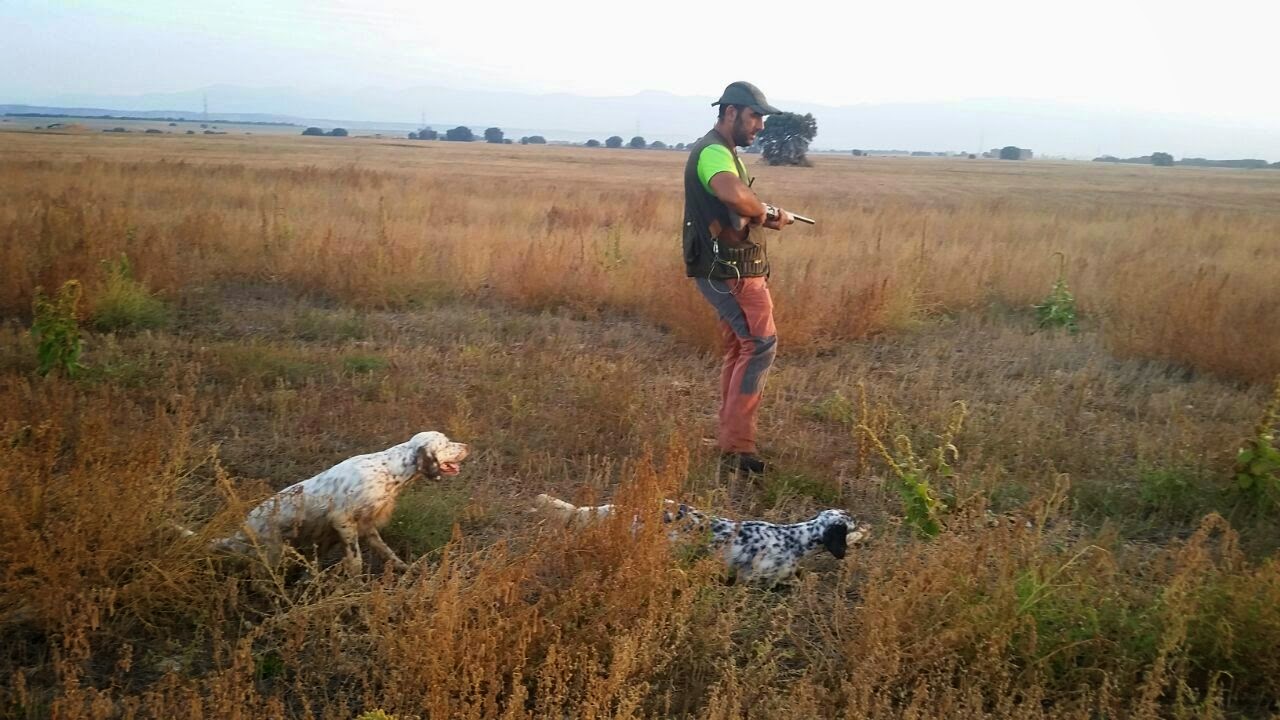
Dog handler/breeder and friend Javier Moya and his great English Setters.

Summer season is on its final phase and without a doubt quails (Coturnix coturnix) are the top hunt for Spanish hunters.
Much has been written and said about the change of habits of this species, becoming abundant where it hasn't been traditionally found and scarce where it used to be common. In my opinion, quails are like the rest of the species: give them food, tranquility and shelter and they'll feel at home.

Once you've found a spot where you suspect conditions are good, the next step is obvious but rarely done: hunt with good dogs!

I'll explain myself:

The common sentences used since modern life away from the fields has become the rule are "There are no quails any more", "These animals don't migrate any more" and others pointing that way. Yes, habits might have changed a bit, but the one thing that has changed for sure is dogs and the amount of hours spent whith them working.


Another beautyful moment. 

Years ago dogs were hunting many hours but nowadays the modern hunters want top dogs which stay in kennels for eight months and hunt like crazy the first day. Well... that doesn't work specially with quails.


Quails can trick our dogs quite easily without even flying. They keep still perfectly camouflaged with the environment and combine this attitude with what they do best: running very quickly through grass without being detected  out of the dog and hunters reach. If quails have decided that the spot where you are hunting suits them, you'll be inside the epithomy of hunting with pointers. This vid shows exactly how important well trained dogs are and why pointers are so special:


These dogs are owned by my friend Javier Moya, English Setter breeder and trainer. Good trainer and good shooter!!

He never shoots a quail that has't been pointed by the dogs, no matter how good the bag has been. Now that is respect!


Nice bag of quails.

The thrill and suspense of the moment combined with the plasticity of the English Setter speaks for itself.


Here's another one:


The first dog to point is a 8 month old bitch after her first quails. A quick translation of the vid: Javier does not even name the succesful double shoot, he greets one dog for the retrieve and job done but he is extremely happy for the young bitch.

These small phasianidae family members are a wonder of nature. Small and heavy for their size, they make a very long trip from Africa to Europe to breed. Who could tell that such a bird would travel that far? That's why we respect them and hunt them responsably, never hunting what we are not going to eat and never shooting to the ones which haven't been pointed by the other main characters of this story, the magnificent dogs.

8 month and already a superstar dog!

The latest agricultural techniques are in my pinion the biggest threat to quail population. Pesticides and herbicides clearly affect their numbers in areas qhere they used to be abundant. Also quicker growing varieties of crops which are harvested earlier, ruining nests and chicks. We should consider the fact of reducing chemicals and returning to old varietals if we still want to hear that "bit-bit-bit" singing which has been our summer companion for centuries here in Spain.


If you ever have the chance to visit Spain for a quail hunt with pointers, don't hesitate; you won't regret it.

Cheers!

Monday, 30 September 2013

BIRD RINGING IN THE CITY

Cetti's warbler (Cettia cetti) ready to be released.

Hi friends!

Autumn has officially started and bird ringing becomes one of the most important activities related to the bird's world (scientificly speaking).
We´ve all seen or have been to bird ringings in the countryside, but bird ringing in the heart of the city is always a great experience. It reminds us that cities are sited in the countryside, and that there are lots of living creatures out there sharing such spaces with us other than the most evident ones that we all know.

Here in beautiful Zaragoza we are lucky to have one of the biggest parks in Spain, a park that combines dry areas with forest ones and the Huerva river, an affluent of the mighty Ebro, as the heart of it.
Such conditions make this park quite special when talking about fauna and flora for it is a natural getaway from the city both through the river and the outer limits of the park itself which are outside the urban area and connect straight to the countryside, allowing "visitors" to enter and leave the park without any barrier.

On sunday the 29th of september, I went with my friend Eduardo to a bird ringing session organized by the SEO/Birdlife Organization.
The expectations weren't very great forthe annual Marathon was taking place and it's start was the park (known as José Antonio Labordeta's Park or simply "The Great Park") itself. 

But, as always, nature offered us a great morrning.


SEO/Birdlife 's  friendly staff ringing birds and answering every question the attendants asked.

First we had a nice walk through the park, watching and identifying bird species, and after the walk, we attended the ringing point where SEO/Birdlife's staff  were ringing and obtaining info from the net captured birds.


Great tit (Parus major) ringing.

Same guy ready for freedom!!

Basically, this is what is need to be done: A special net is set to capture the different species of birds. The birds are put into special fabric bags individually in order to reduce stress. Then the birds are ringed, weighed, measured and checked one by one.
Bird ringing is very important for it provides us with vital information about the specimen itself, tellling us where it has been captured before, its age and sex, its health or the time of the year when it is living in the capturing zone, and about the species in general (frecuency of captures of the same species, health,...).
All the results are communicated to other bird studying oganizations in order to have a global knowledge of the matter.


Young female Eurasian Blackcap (Sylvia atricapilla) being ringed.

Checking the muscular fat and general muscle proportion of the same specimen.

Ready to go!!


Let me tell you how to check the muscular proportion and intramuscular fat of a bird: you blow a little air in order to remove some of the feathers from the chest and belly of the bird and compare what you have seen with an index with basic drawings. This information will tell you about the general state of the bird: if it is well fed, ready to emigrate, just arrived, ill,... 


Measuring, weighing and releasing of an European Pied Flycatcher (Ficedula hypoleuca).

The ringing was focused in small birds, with different species being ringed and released (plus a Short-Toed Treecreeper - Certhia brachydactyla - previously ringed from which we obtained data), being young Eurasian Blackcaps (Sylvia atricapilla) the most frequent, followed by European Pied Flycatcher (Ficedula hypoleuca).


 Young Eurasian Blackcap (Sylvia atricapilla) males.


Very important!!: these kind of actions, though very important and necessary to zoology, provide the birds a certain amount of stress which differs from one species to another and from individuals of the same species too, so, try to be as brief and quick as you can be whenever manipulating a bird and, if you can, check the most easyly stressed ones first in order to release them as soon as possible.


Checking and ringing a Short-Toed Treecreeper(Certhia brachydactyla).
This species are easyly stressed, so the ringer must be specially quick and calm to get all the info and release the bird.

Ask your local bird studying organization about ringing activities and don't hesitate to book yourself in one of them.
There's a lot to see, a lot to do and a lot to learn!!


  Thanks SEO/Birdlife!!


Wednesday, 28 August 2013

SPANISH IBEX: GLUED TO THE WALLS

A group of males of different ages (Capra pyrenaica hispanica)
Hi!
Here's a thougth which I think we've all had;
How many times have you been walking down a steep hill trying not to fall, moving across a fallen leaves forest floor trying not to make too much noise, leaping from one side to the other of a ditch fearing falling into it or just running as fast as you can through a bushy area ending tired and feeling a bit clumsy and then you think: "How can animals do this and how can they make it look so easy?!!

Well, this thought and the sensation of clumsiness are never as evident as they are when you watch the Spanish Ibexes (Capra pyrenaica).
The way they run and leap across cliffs and steep hills like nothing always amazes me. 
These animals, like other mountain species, are made to live in these tough areas where very few animals, specially mammals can dwell. Their hoofs are designed to hold on to any ledge or protrusion of the surface with incredible efectiveness and accuracy.


A female, her last year's calf and this spring's calf making this wall seem like a normal floor.


All ibexes and species alike are capable of these abilities, but the true power of this one in particular is its adaptability to other environments.
Not so long ago, Spanish Ibexes where very hard to find and they were at the verge of extinction. In fact, of the four subspecies located in the Iberian Peninsula, only two remain alive. The one living in the west-norther part of Spain disappeared at the end of the XIX century due to excess of hunting pressure (probably the loss of proper habitat, the natural predators and the excess of hunting combined altogether were the true reasons). The Eastern-northern one, the one that gives the scientific name to the species, the one that lived in the Pyrenees, lost its last member in January 2000, showing what in my opinion is the "how not to protect a species" way of doing things. Both of the extincted species were just "non profitable". Its hunt was forbidden and they were expected to live in protected areas where human activities were not allowed. On the contrary, the other two species were managed in a more clever way. Its hunt was regulated, allowing local economies to value them as a main way of income. This, combined with the lack of predators and proper agricultural management, evolved in one of the best examples of natural territory expansion.
Nowadays, you can find Spanish Ibexes in areas where there have never been any (at least since the stone ages).


Yes,we're back!!

The only place in the world where you can find this species is the Iberian Peninsula,  with almost the entire population sited in Spain.
In my area, they are expanding very quickly, and if you are lucky, you can spot them just outside the city of Zaragoza. Obviously, the best thing to do if you want to watch them is to go to rocky and montainous areas. I am lucky to have as a friend one of the guys who know more about them, at least in Aragón, so whenever I want to find big old males with spectacular horns, he gives me precious info and advice. Shame I'm such a bad photographer!!


This group of males is placidly searching for a place to spend the night.
 Big horns, old males.


I at My Little Eden (see old post) have a couple of herds. The first individual to appear was a young male around 2003. Now there are around 40 to 50 animals and they are continuing with their expansion.
In particular, there are two females which are specially fond to the most humanized area of the place, and they are now starting their own herd. Oh, just one thing; the fact that they live in the most humanized area does not mean they are easy to spot. I myself have spent many hours just to be able to take a few pictures from the distance.


These are the goats that live near the humanized areas; yes, those two spots in the field. 
try and get closer if you can!!

... and this is the herd they are forming.

It's always a pleasure to come across these almost mythical animals, specially in these days when other animal species numbers are going down.

So, as always, if you come to Zaragoza or nearby and you want to watch one of the most beautiful ibexes in the world, I'll be pleased to take you there!!!


Wanna see them?


Have fun and enjoy the nature that surrouds you!

Monday, 12 August 2013

ROE MY DEER!!!

Hello again!
This post is about one of my favourites: roe deer!!

We are in the peak of the summer and temperatures are really high, above 35ºC most of the time...tough times for every living creature around this area.
But there's one species that comes particularly active during this time of the year, specially at dusk and dawn: roe deer.


Young male roe deer suspecting something...


The mating season takes place in July, but from June until August you can enjoy watching this beautiful animal if you don't mind getting up early or waiting patiently near the crop fields late in the afternoons. If you are careful enough, you'll be rewarded with what in my opinion is one of the best sights nature can offer. A roe deer placidly eating while the sun sets or, if you are lucky, a couple of them chasing each other playing Romeo and Juliette are images that will endure in your memories forever.


"Don't run away from me my Deer..."


The secret is to be very quiet, move slowly and, the most important thing of all, make sure the wind comes "from the watched and not from the watcher". The senses of a roe deer are very developed, mostly hearing and smelling. Don't forget that human scent means danger for all animals, so never use perfume, cologne, deodorant and stuff like that; you might think it covers your personal "fragrance", but in reality, the mixture ot the perfume and your skin odour is much more potent and thus threatening for them.
In this video you can see how to precede. Notice that the wind never gets from me towards the deer, I'm in a higher position, so the chances of getting detected are less, and I dont move or make any sound.


Is there a nicer way to see the sun set? 


Of course, you can enjoy the presence of these animals the whole year, 'though from December up until May, these "forest dwarves" as we call them around here, become undetectable. Notice that this is when males loose their antlers and females are at the end of their pregnancy or taking care of the newborns. Also, in this time of the year, it is not very clever to search for them (or any animal at all) insistenly for this is the time when they need to bee focusing on raising their babies and thei need to feel secure. So, never search the same areas and, if you do, limit your activities to quiet and relaxing walks, but be eyes wide open for there are many traces of animal activities; e.g.:


A fallen antler can easily be mistaken with a dried tree branch, but it's a definitive proof of deer activities.


Young pine used as a brush to mark a male's territory and to remove the velvet from the young antler.


If you find fallen antlers, droppings, "beds" in wind protected areas, young bushes which have bee used as "scratching brushes" or footprints, you have to know that very close there's a huge chance that one of these graceful animals is watching you for they are very loyal to their everyday territories.


Who played Barry White a few minutes ago?


"Let's find a less crowded place my Deer, I think we're not alone"


So, next time you come to Zaragoza, if you want to spend a couple of hours getting away from the day heat and watching these animals in these incredible landscapes, I'll be pleased to take you there. 
You'll never forget it.