Showing posts with label Hunting. Show all posts

Sunday, 21 February 2016

5 DAY TRAIL CAMERA RESULT

Huge Wild Boar just the next day after setting the cam.

Hi again!

Long time since my last post but life is sometimes busier than one would like, but let's get back to business.

Trail cameras are an inestimable help for many wildlife lovers: from hunters to wildlife managers or simply someone who likes to see what roams in a certain area, they are, at least for me, a true discovery.
You can take photos or videos (I prefer photos, they make batteries last longer and give me that "stealth" feeling which a video lacks).
This model in particular (Keep Guard is called, made in China), takes colour pictures during daylight and black and white ones at night. The cool thing is that the flash is an infrared one so the animals do not detect it. It also doesn't make any noise when taking the pic although some animals look at the camera, making me think that they do sense something.

A friend lend me one a couple of weeks ago and I decided to set it in an area where I think there's mostly boar and forest animals activities.

I set the trap on a sunday morning and went to check it five days later and the results have been better than I expected; you can't imagine what a fistfull of corn a couple of oranges an an apple can do!

The camera started to catch images from the next day and the first visitor was a huge male boar.


No one messes with a pig this big!


Needless to say that having a top dominant animal in the area would decrease the chances to see meny other animals, but there are always brave ones who accept the challenge, and among of them are badgers: tough, brave and self confident. And there's one who came a few times:


Brave badgers don't fear big boars.


A couple of nights after, some more boars came but, as always, the big ones get the best spots. At first they enter the site with caution but once they feel safe...


Nice thighs!


It is always a thrill knowing that there's such a great wildlife around us and with this "toy" we can be aware of it, helping us to find from a certain invididual which we want more information from to de different species that dwell an area. 

The trap is now set in another place, it is now a matter of a few days to see the results.


Oh!, look who our last visitor was:


Mr Badger!!!!!

Cheers!

Friday, 19 December 2014

THE LEGENDARY WILD BOAR


If there's an animal in Old Europe that brings together admiration, respect, fear, courage, wittiness and stregth, that must be, besides the brown bear, the Wild Boar (Sus scrofa).
Present throughout Continental Europe and recently recolonizing the British Isles, this extraordinary animal has Spain as one of its paradises.
The population reaches high numbers but, in contrast to Central and Northern European populations, you seldom find them in huge sounders. This might be an adaptation to Spain's montainous surface and the huge amount of food they can find almost everywhere and all year round. This fact makes wild boars presence common throughout the Country, but the lack of a big sounder that brings safety and protection to an indvidual makes them behave slightly different from other populations.

In here, boars are tough and ready to fight if they feel in real danger. And there's a fact that makes them extremely fearfull of humans: they are hunted all across the nation. This means that almost the entire population knows that after a dog comes a human, so, if they feel they can't escape easily, they will choose the quickest way, and that is to fight.
Here in Aragón, boar hunts are very traditional, and new farming techniques have risen numbers of boars to a point of plague in some places. The good news is that wild boar's meat is a delicacy and in rural Spain is one of the most popular dishes during the hunting season.
In my opinion, as for big game species is concerned, they are the most clever ones. Only if you have a trained eye you will be aware of their presence, although you might not even see them.

It always amazes me the capacity they have to hide in the smallest places without being discovered and at the same time leave such an amount of traces!
If they have prospected an area for food, the next morning it would look like a farmer has been there working. If they have taken a mud bath, the amount of rubs you can find in certain trees, rocks or other surfaces are enormous. Images speak loder than words.


A sounder of wild boars have spent a nice mud bath last night.


Huge rub after mud baths. That slim tree will probably die after a few more rubs.


You can clearly apreciate the rubbing areas against the tree and the floor.

As you might have noticed, taking mud baths and rubbing themselves against rough surfaces atferwards is one of their biggest pleasures. They usually have their favourites trees or rocks to do so, visiting them regularly, even to the point of killing a tree after many years of trunk damaging. You can also determine how long the boars have been there by the dampness of the mud and the freshness of the footprints.


Fresh footprint.

One of the tracks you might also find are feces, but I've always found them away from these "mud spas" they have. People think boars are dirty; nothing further from the truth. They are probably one of the cleanest animals you can find in our forests, even taking their every night mud bath.


A few days old feces. 

I've had many encounters with boars in my life, and except a few times when I saw them before they saw me, the most common way was to incidentally flush them from a very close bush. You wouldn't believe their hiding skills, sometimes even having a six or seven member sounder inside a restaurant table sized bush.

Clever, strong, fierce and always alert. That is the legendary Wild Boar.

Monday, 8 September 2014

TOP ENGLISH SETTERS AND WILD QUAILS

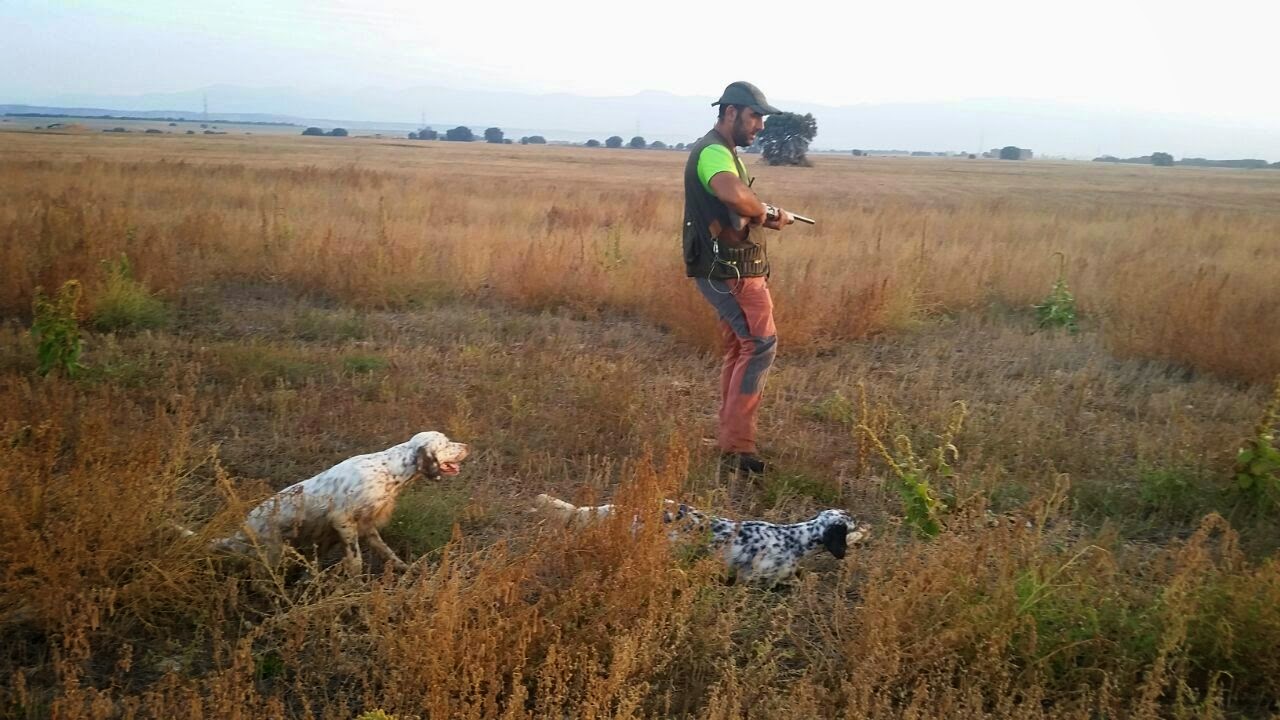
Dog handler/breeder and friend Javier Moya and his great English Setters.

Summer season is on its final phase and without a doubt quails (Coturnix coturnix) are the top hunt for Spanish hunters.
Much has been written and said about the change of habits of this species, becoming abundant where it hasn't been traditionally found and scarce where it used to be common. In my opinion, quails are like the rest of the species: give them food, tranquility and shelter and they'll feel at home.

Once you've found a spot where you suspect conditions are good, the next step is obvious but rarely done: hunt with good dogs!

I'll explain myself:

The common sentences used since modern life away from the fields has become the rule are "There are no quails any more", "These animals don't migrate any more" and others pointing that way. Yes, habits might have changed a bit, but the one thing that has changed for sure is dogs and the amount of hours spent whith them working.


Another beautyful moment. 

Years ago dogs were hunting many hours but nowadays the modern hunters want top dogs which stay in kennels for eight months and hunt like crazy the first day. Well... that doesn't work specially with quails.


Quails can trick our dogs quite easily without even flying. They keep still perfectly camouflaged with the environment and combine this attitude with what they do best: running very quickly through grass without being detected  out of the dog and hunters reach. If quails have decided that the spot where you are hunting suits them, you'll be inside the epithomy of hunting with pointers. This vid shows exactly how important well trained dogs are and why pointers are so special:


These dogs are owned by my friend Javier Moya, English Setter breeder and trainer. Good trainer and good shooter!!

He never shoots a quail that has't been pointed by the dogs, no matter how good the bag has been. Now that is respect!


Nice bag of quails.

The thrill and suspense of the moment combined with the plasticity of the English Setter speaks for itself.


Here's another one:


The first dog to point is a 8 month old bitch after her first quails. A quick translation of the vid: Javier does not even name the succesful double shoot, he greets one dog for the retrieve and job done but he is extremely happy for the young bitch.

These small phasianidae family members are a wonder of nature. Small and heavy for their size, they make a very long trip from Africa to Europe to breed. Who could tell that such a bird would travel that far? That's why we respect them and hunt them responsably, never hunting what we are not going to eat and never shooting to the ones which haven't been pointed by the other main characters of this story, the magnificent dogs.

8 month and already a superstar dog!

The latest agricultural techniques are in my pinion the biggest threat to quail population. Pesticides and herbicides clearly affect their numbers in areas qhere they used to be abundant. Also quicker growing varieties of crops which are harvested earlier, ruining nests and chicks. We should consider the fact of reducing chemicals and returning to old varietals if we still want to hear that "bit-bit-bit" singing which has been our summer companion for centuries here in Spain.


If you ever have the chance to visit Spain for a quail hunt with pointers, don't hesitate; you won't regret it.

Cheers!

Monday, 25 February 2013

TRADITIONAL "END OF THE SEASON" MEETING


On a nice and sunny February the 17th 2013, friends and clients gathered at the traditional meeting I always organize at the end of the hunting season.
Although it isn´t really over yet, I really think there´s no need to push the limits as in the last few years spring seems to come earlier than it always has, making animals act less elusive, not to say that some of them are in the beginning of the mating season or already pregnant. Now it´s time to go birdwatching, flora identifying, hiking or just enjoying a nice and quiet walk surrounded by nature.
But back to the meeting; I invited 20 good friends to enjoy the last day of wild boar hunting (Sus scrofa ).
Here´s what we usually do:
First I set every hunter in its place, where he has to stay quiet and avoid moving around (that way they make themselves quickly disguised amid the wild and obviously for safety reasons).
Then the hounds are released following a specific and strategic plan and the hunt begins.
Only wild boars and foxes ( Vulpes vulpes ) can be shot to, neither roe deer nor ibex for it is more management than hunting in this case; I´ll explain: Wild boar population needs to be controlled for there are no natural predators nowadays (or very few of them) and their breeding success is very high. Same happens to foxes. If they are not controlled or at least "bothered" in some ways, their influence in the environment could be really important as they prey on almost everything (specially boars). On the other hand, you cannot manage a roe deer population by hunting them without knowing if it´s a doe, a buck or a fallow, as they rush to where hunters are giving little time for the hunter to identify what type of animal is coming. That is not a problem with foxes and wild boars due to the big litters they have in contrast to the 1-2 babies deer or ibexes have per season.
But the best part comes after the hunt.
We set a nice fire to warm ourselves up and in that same fire I cook for my guests and we discuss the hunting (lots of lies, jokes and laughs) in the meantime.
This year I made a typical country dish: "rancho", which basically has to have rice, potato, vegetables and some meat on it. There´s plenty of ways of making it, as many as you can imagine. In this case the ingredients where: rice, garlic, onion, red pepper, green pepper, leek, tomato, turnip leaves, carrot, potato, veal, rabbit, chicken, pork, chorizo sausage, longaniza (a typical variety of spicy sausage from this region), black pepper, olive oil and chicken soup.

Heavy dish, hu?!
In the end, hugs, " 'til next season" goodbyes and the last jokes made this meeting one to remember.
Beautiful spring is coming...

Monday, 4 February 2013

Great Hawking Day!!!


On the 19th of February I took a couple of clients for a hawking day trip. The weather was cloudy, with alternate rain and wind, not the best day for the hawks to fly after preys!.
Anyway, thanks to the dogs job we were able to see a few flights after some rabbits (Oryctolagus cuniculus), a hare (Lepus granatensis) and some red legged partridges (Alectoris rufa) which were, by far, much quicker than the harris hawks (Parabuteo unicinctus ).
One of the hawks caught a rabbit in a beautiful and dramatic chase which I couldn't catch on film but in the video you can watch the aftermath of it. Notice how the hawk claims the property of the catch and does not allow other than her master to come close.
This time, the brave rabbit was overpowered by the hen hawk, but it took her 5 flights to be successful (without counting the hare or the partridges).

This hen Harris hawk did a great job

You might like it or not, but it's definitely a sustainable way of hunting to which you have to add the teaming of three different species to have success over another.
Plus, and I think anyone would agree, there are very few things as beautiful and powerful as a bird of pray hunting.