Showing posts with label Gastronomy. Show all posts

Friday, 19 December 2014

THE LEGENDARY WILD BOAR


If there's an animal in Old Europe that brings together admiration, respect, fear, courage, wittiness and stregth, that must be, besides the brown bear, the Wild Boar (Sus scrofa).
Present throughout Continental Europe and recently recolonizing the British Isles, this extraordinary animal has Spain as one of its paradises.
The population reaches high numbers but, in contrast to Central and Northern European populations, you seldom find them in huge sounders. This might be an adaptation to Spain's montainous surface and the huge amount of food they can find almost everywhere and all year round. This fact makes wild boars presence common throughout the Country, but the lack of a big sounder that brings safety and protection to an indvidual makes them behave slightly different from other populations.

In here, boars are tough and ready to fight if they feel in real danger. And there's a fact that makes them extremely fearfull of humans: they are hunted all across the nation. This means that almost the entire population knows that after a dog comes a human, so, if they feel they can't escape easily, they will choose the quickest way, and that is to fight.
Here in Aragón, boar hunts are very traditional, and new farming techniques have risen numbers of boars to a point of plague in some places. The good news is that wild boar's meat is a delicacy and in rural Spain is one of the most popular dishes during the hunting season.
In my opinion, as for big game species is concerned, they are the most clever ones. Only if you have a trained eye you will be aware of their presence, although you might not even see them.

It always amazes me the capacity they have to hide in the smallest places without being discovered and at the same time leave such an amount of traces!
If they have prospected an area for food, the next morning it would look like a farmer has been there working. If they have taken a mud bath, the amount of rubs you can find in certain trees, rocks or other surfaces are enormous. Images speak loder than words.


A sounder of wild boars have spent a nice mud bath last night.


Huge rub after mud baths. That slim tree will probably die after a few more rubs.


You can clearly apreciate the rubbing areas against the tree and the floor.

As you might have noticed, taking mud baths and rubbing themselves against rough surfaces atferwards is one of their biggest pleasures. They usually have their favourites trees or rocks to do so, visiting them regularly, even to the point of killing a tree after many years of trunk damaging. You can also determine how long the boars have been there by the dampness of the mud and the freshness of the footprints.


Fresh footprint.

One of the tracks you might also find are feces, but I've always found them away from these "mud spas" they have. People think boars are dirty; nothing further from the truth. They are probably one of the cleanest animals you can find in our forests, even taking their every night mud bath.


A few days old feces. 

I've had many encounters with boars in my life, and except a few times when I saw them before they saw me, the most common way was to incidentally flush them from a very close bush. You wouldn't believe their hiding skills, sometimes even having a six or seven member sounder inside a restaurant table sized bush.

Clever, strong, fierce and always alert. That is the legendary Wild Boar.

Sunday, 8 December 2013

MUSHROOM PICKING IN ARAGÓN

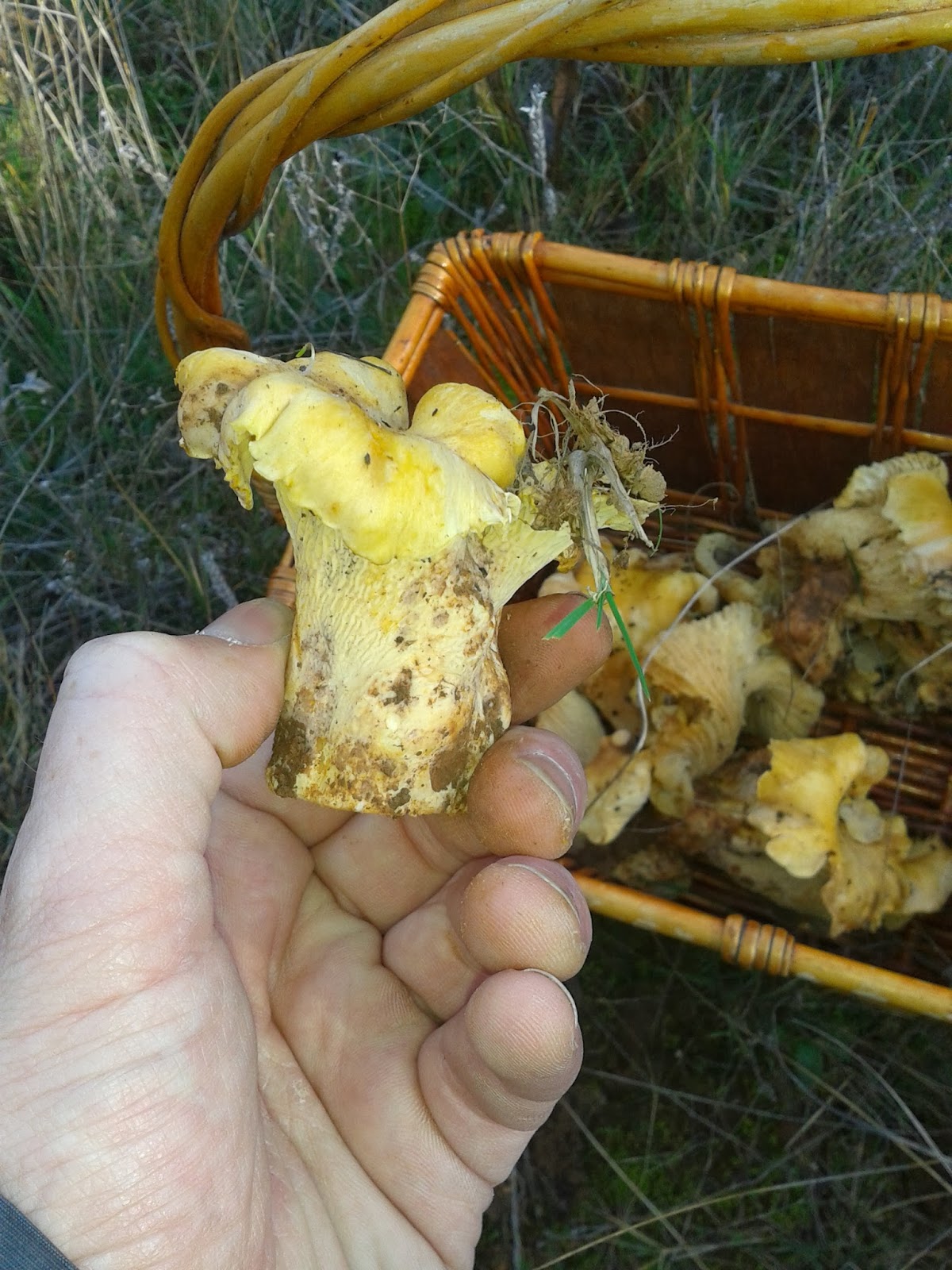
A basketful of Yellow foot (Cantharellus lutescens)

Autumn is about to end, and with it, one of my favourite activities: mushroom picking.
I am not going to tell you the do's and don'ts about mushroom picking (you know, all that crap about the poisonous species, how dangerous is to eat something that you don't know what it is...) for there are many ways to do things: you can collect mushrooms in order to eat them, to study them, take pictures or whatever the end you want to give them. That includes poisoning people!!!  Hahahaha, just kiddin'.

In my case, I usually collect the ones I want to eat, but I like to take home (aways in a separate basket) the ones I don't know much or nothing about and check them with the help of guides, internet or micology experts.

But there's one thing I like to do the most, and that is taking people mushroom picking and showing them the way I do it.

One of the coolest things about this activity is that since you are searching the forest floor for mushrooms most of the time, you discover many other things you normally skip when doing other activities, such as animal traces, plants, other mushrooms, ...

Spain is a very rich country referring to nature, and mushroom species are not an exception. Where I live (Aragón), because there are many different soils and climates, you can almost find every species that grow in the rest of the country. Since this is not a mushroom guide, I'm just going to focus on a few species.


This girl had a special eye for Yellow Feet. After an hour her basket was full.


The first of them is one of my favs: Yellow Foot (Cantherellus lutescens). It grows in high areas, usually related to pines and a certain type of moss. It is a very endurable mushroom, and it can stand quite low temperetures in comparison to the rest of the species. It grows in groups, in "whitches rounds" as we usually call them.


A close-up of  this mushroom.


Another one. These ones were picked frozen and with temperatures down to -3º C.


Yellow feet under bushes: that's why it looks as if it was night time!


They never carry worms or insects, and they are very easy to dry in order to preserve them. This year  has been a great Yellow Foot year, and the people I've taken mushroom picking have found it as the most entertaining of the species to pick. That is because when you find one, you usually find a lot f them around.
If you collect them frozen, they can return to their normal textura after a few hours at home. Obviously this happens if they haven´t been frozen for many days.
I love them in omelettes, rices or soups.
But let me show you the results of a couple of hours collecting them (the pictures were taken in different days):

In just 2 hours!!

Ready to deliver to my friends!

One of my friends, the always shy José Ramón. He had never had so much fun picking mushrooms! 

Another species I like to search for is the Chanterelle Mushroom (Cantherellus cibarius).
This one grows in sunnier areas, usually related to the  Quercidae family (Oaks and similar). It also grows in groups, and usually when you find one, you must search for a few more nearby.


A nice and big Chanterelle (Cantharellus cibarius)


All these were picked up within a 1,5 metre radius.


They are an excellent mushroom for eating purposes, one of my favourites. The flavour is peach like, sweet and soft in mouth. After cleaning it, you tear it up (forget about cutting this one) and you use it the way you want. I like to cook them as a dessert, boiling them in syrup and dipping them in hot chocolate.
They are a very easy to dry species too.

Mmmmmm...a taste you'll never forget.


Next mushroom, and related to the previous two, is the Horn of Plenty (Craterellus cornucopioides).
It grows in similar areas as the Chanterelle. They also grow in groups.
The taste of this one is more "forest like". Toasty flavoured and very "autumn reminder".


Nice specimen picked up by my friend Fernando.


I like to cook them with rices, omelettes, soups and stews. 
And, by the way, this one doesn't stand very low temperatures.
They can be easyly dried.


Here mixed with a few Chanterelles. Nice looking picture, yes Sir.
.
Fernando's starting of the day.

The following species is one of Spain's favourite:  Saffron Milk Cap (Lactarius deliciosus).
It grows in forests, usually whith quercus and pine presence. It is a beautiful mushroom and a very tasty one. These family is a very wide one, with some mild poisonous species. But don't worry, they are easy to differ: If when you cut them, they secrete a white milk, you must not eat them. They must secrete a saffron like milk or a red wine like milk in similar species (Lactarius 
sanguifluus).


Don't try to hide. You've been spotted my Lactarius friend.


Saffron Milk Caps mushrooms and Yellow feet... you can go back home with a smile on your face.

Many of them are host to a certain species of maggot. I never take home the ones with maggots, but people from our closest region (Catalonia) usually eat them and there's no problem with it other than eating extra protein!
We usually eat them fried with olive oil and garlic or even roasted.
They are also lovely with stews.


Yellow feet and Saffron Milk Cap mushrooms with beans and pork. yes, they taste even better than they look.


Our next guest is the Hedgehog Mushroom or Sweet Tooth Mushroom (Hydnum repandum). 
Here in Spain is not often eaten, though it is gaining popularity in recent years. I collect them usually in mixed pine and oak forests. They grow just like the Chanterelles and in fact, they look very much alike, but as soon as you take a look at the gills, there's no mistake: they are spined look more than gilled look. In Spain we call them "Cow's tongue" or "cat tongue" due to the looks of it.


 Notice how the gills of the Sweet Tooth (Hydnum repandum) look like spines (or like a cows tongue!!)


They are quite fragile to pick, but with a bit of practice and being careful, there should't be any problem in fillilng a basketful of them once you've found their growing places.
The best ones to eat are the small ones. When they are big and old, they develop a bitter taste which I personally don't like that much. If they are big, I boil them before using them, throwing the used water away.
They are lovely with rices and wild game meat.


 Blewit and Sweet tooth. Future red legged partridge stew companions.


One of my favourites is the Grey Knight (Tricholoma terreum).
We also call it Pine Mushroom, Mouse or Roedeer's nose due to the "hairy like" covering of the cap.
They grow in pine areas, usually in large groups.


 This ones were picked in less than half an hour.


They are usually eaten in omelettes or scrambled eggs.
In my opinion, one of the best ones to eat. 
They usually carry tiny bugs. I confess, I do not worry about them and eat the mushrooms as if they didn't exist.


And last but not least:
Blewit.
They usually grow in organic debris, and, specially when they are young, their gills and stem have a beautiful lavender tone.
They are also host to some worms like the Lactarius Sp.


Notice the pale lavender colour of the gills.


They have a slight anissette fragrance and they must be cooked if you want to have a pleasent meal!.
They taste great in stews.

So this is just a tiny example of what to do if you are in Zaragoza or in Aragón in autumn.
Great times, great season to go out for a walk in good company and always coming back home with something new learned.

Hope you've liked the different species we have around here.
There are a lot more, so, if you want to come mushroom picking, Aragón is one of the best places in Spain.

See ya!


Saturday, 25 May 2013

WILD GREEN ASPARAGUS HARVESTING

The result of half an hour of harvesting.

One of the most relaxing and pleasant things to do when spring arrives arround Zaragoza is going wild asparagus (Asparagus acutifolius) picking.
If you've been mushroom picking, you might find it very similar. I always search in the bushy and shady areas of these dry  landscapes of ours, where Quercus coccifera and Ephedra ssp. grow amid our typical pine trees (Pinus halepensis).
I like to search for them specially in March or early April in order to find the tenderest ones before they start to get "woody", because what you pick is what will turn into the stalk of the plant, so after a few days the asparagus becomes less tender as lignin contents in the plants composition grow higher.

What you have to look for is this:


The green thin stalk is the asparagus we are looking for. As it grows amid other plants, sometimes it isn't easy to see , so what you have to do is look for the rest of the plant. If you look at the picture, you can see a dry twisty branch to the left; that's what we're looking for. If you find this year's branches, it's even easier, for they are dark green, twisty and with tiny spiny leaves.
Once you've located the asparagus, bend the stalk carefully from bottom to top until it breaks, so that way you'll only take home the tenderest part and leave the rest, which will give the stalk more chances to survive.
If you want to, specially if you are going to cook them the same day you've picked them, something I strongly recommend, take a few bites to a raw and fresh one so you can find all the flavours and the mixture of sweetness-bitterness they have. Later on, when you eat them cooked, you'll get the complete asparagus experience, and you'll remember those bites you took to that wild fresh one. You'll always remember that flavour (in fact, right now, while I'm writing, I can feel it in my mouth!) 
The rest of the search is just wandering around enjoying the environment for rushing is the least thing you have to do; you will miss lots of asparagus if you are in a hurry!!
By the way, dont forget to keep quiet and taking your bonoculars whith you, you'll see lots of birds, remember we are in early sping and there's great activity out there!
So, after more or less half an hour, once you're trained in searching for them, this is what you can get home with ...

700 gr of forest vitamins!!!


And at this point you probably will be asking me: "What can I do with them?"; well, as always, that depends on your cooking skills, but if you're not a Bocusse or an Adriá, you are lucky with these thin green friends: they are so tasty that you just have to put a bit of olive oil in a frying pan, fry them, and ad some salt before serving; or even easier; put some olive oil in a a plate, put the asparagus on it, add some more oil and microwave it setting the microwave to the maximum power for like 6-7 minutes, add salt and enjoy!!
Traditionally, around Zaragoza they are eaten either in an omelette or in scrambled eggs. The first option is  the way I chose to cook them. Here goes the recipe:
First wash the asparagus in order to get rid of dust and little insects; then cut them into smaller pieces (as small as you wish to do). I prefer to cut them into 3-4 cm pieces because I like to feel them when I eat them.
Then, I put some olive oil in a pan and when it is at more or less 120º C (if you want them a bit crunchy, very hot oil, if you like them soft and tender, you can "boil" them in colder oil) I add the asparagus. Don´t put too much oil, more or less a spoonful, in order to avoid an oily omelette, which is something people usually don't like. You can always add more oil while you are cooking.


 Cut the asparagus into pieces and fry them.


Once you have the asparagus the way you like them, add the trodden egg, stir it for like 10 seconds and let it dry a bit. Once it reaches the "turning point" omelettes have, turn it upside down, wait one minute and...ready to eat!!

If you want the omelette to look visually perfect, use more than one egg. In my case, I prefer less egg and a less "perfect" omelette. It's not because I don't like egg (specially this one, which comes from my aunt's hen house, where hens are fed only with natural food and eggs taste more or less the way Heaven must taste), it's just because I want the maximum wild asparagus flavour in my omelette!!


 Forget visual perfection ... once it's in your mouth you can feel the world stopping!


While you are eating them, the flavour is so different from other commercial asparagus that you start to remember the time you spent searching for them and you find it has been worth it. They have a much more potent "aroma", with the exact amount of bitterness that the farm ones don't have.

Next spring, if you're coming to Zaragoza, don't forget to ask me to go asparagus picking ... a really nice experience and a very different way to know the wild environment that surrounds my city.
See ya!


Tuesday, 12 March 2013

THE KING AIN'T DEAD, HE'S IN ZARAGOZA AND HE'S HAVING TAPAS!!!!!!

Rosa has it clear: the King knows about tapas.

So you thought Elvis was dead hu?, well, he is not. He is alive and kickin', and you can have some tapas with him in the center beautiful Zaragoza and I tell you they're all right Mamma!! 

Placed in Reconquista Street 5, next to the strategically sited San Miguel Square, right in the center of the city, this place offers you more than meets the eye.

I knew about this place but I had never entered in it until last sunday and boy, what was I missing!

From the outside, almost nothing tells you about what is going on inside, it's just the typical all time tapas and snacks bar that you can find enywhere in Zaragoza (don't be mistaken, typical does not mean low quality, it's just that there's a lot of offer of them), but once you enter the place surprises como one after another.

Who can tell the King is inside?

At first, what catches your attention is the decoration: it's Elvis everywhere; driving liscenses, photos, record sleeves, posters, action figures and plenty of memorabilia. Of course, you can hear him throug the speakers the whole time.
But the best part is about to come: take a look at the tapas and snacks they have at the bar stall and then you know you've come to the right place. Loads of high quality stuff paying attention to local gastronomy in the first place. Just to give you an idea: migas, bullring bull stew, red peppers stuffed with cod, cod croquettes, chorizo and longaniza sausages, chopped fried pork ribs, and a large etcetera. 
They have the special "Elvis tapa", which consists of grilled baby squid, fried green pepper from Padrón (the "lottery" pepper, some are hot, some are not, ) and roasted potato with sone garlic flavoured olive oil and parsley.
Oh, I forgot! Every tapa costs one miserable euro, and everyday from 19:00 to 21:00 you can have your tapa and your drink for 1,50€.
And everyday they have a very cheap menu that costs 8€. It's homemade and it does look good (I didn't have it but there were people having it and it seemed quite fine).

The sight of the bar stall left me "all shook up".

Rosa Miranda, owner of the bussiness, was very kind and answered every question we asked her. She told us about her visit to Menphis on the 30th anniversary of the King's death and she showed us some pictures.
The atmosphere was great, and you could tell by the amount of clients greeting Rosa that there'es quite an important amount of everyday costumers, which speaks for itself about the bussiness and the way they treat their clients.

Once the tapas are served ther'es a little less conversation and a liitle more action.

If you want to try traditional homemade dishes at very reasonable prices, be served as if you were a friend, or you just want to have a beer with Elvis, now you know where to go!!

I think this is going to be a must in the tapas tours I offer to my clients... and my own ones too!!!


Monday, 25 February 2013

TRADITIONAL "END OF THE SEASON" MEETING


On a nice and sunny February the 17th 2013, friends and clients gathered at the traditional meeting I always organize at the end of the hunting season.
Although it isn´t really over yet, I really think there´s no need to push the limits as in the last few years spring seems to come earlier than it always has, making animals act less elusive, not to say that some of them are in the beginning of the mating season or already pregnant. Now it´s time to go birdwatching, flora identifying, hiking or just enjoying a nice and quiet walk surrounded by nature.
But back to the meeting; I invited 20 good friends to enjoy the last day of wild boar hunting (Sus scrofa ).
Here´s what we usually do:
First I set every hunter in its place, where he has to stay quiet and avoid moving around (that way they make themselves quickly disguised amid the wild and obviously for safety reasons).
Then the hounds are released following a specific and strategic plan and the hunt begins.
Only wild boars and foxes ( Vulpes vulpes ) can be shot to, neither roe deer nor ibex for it is more management than hunting in this case; I´ll explain: Wild boar population needs to be controlled for there are no natural predators nowadays (or very few of them) and their breeding success is very high. Same happens to foxes. If they are not controlled or at least "bothered" in some ways, their influence in the environment could be really important as they prey on almost everything (specially boars). On the other hand, you cannot manage a roe deer population by hunting them without knowing if it´s a doe, a buck or a fallow, as they rush to where hunters are giving little time for the hunter to identify what type of animal is coming. That is not a problem with foxes and wild boars due to the big litters they have in contrast to the 1-2 babies deer or ibexes have per season.
But the best part comes after the hunt.
We set a nice fire to warm ourselves up and in that same fire I cook for my guests and we discuss the hunting (lots of lies, jokes and laughs) in the meantime.
This year I made a typical country dish: "rancho", which basically has to have rice, potato, vegetables and some meat on it. There´s plenty of ways of making it, as many as you can imagine. In this case the ingredients where: rice, garlic, onion, red pepper, green pepper, leek, tomato, turnip leaves, carrot, potato, veal, rabbit, chicken, pork, chorizo sausage, longaniza (a typical variety of spicy sausage from this region), black pepper, olive oil and chicken soup.

Heavy dish, hu?!
In the end, hugs, " 'til next season" goodbyes and the last jokes made this meeting one to remember.
Beautiful spring is coming...